Clients & Ventures

Product/systems design that turns AI tech into business results


































Contact Us
Contact form or information will go here.
Project Detail



Contextus
Summary
A context-native workspace that turns scattered AI interactions into persistent, inspectable knowledge systems.
Most AI tools force people to repeatedly reconstruct their goals, knowledge, preferences, and working context while hiding which information actually shaped each response.
I designed Contextus as a unified workspace where documents, conversations, knowledge, prompts, memory, and models become explicit components of a reusable AI environment.
Outcome
From temporary chats to a compounding knowledge system.
Contextus reframes AI work around continuity and control.
Instead of rebuilding context for every task, users can create reusable profiles for activities such as research synthesis, strategy reviews, technical validation, or writing. Instead of trusting invisible memory, they can inspect and correct the information that will shape future responses. Instead of leaving useful AI output buried in chat history, they can convert it into durable knowledge.
The resulting workflow creates a closed knowledge loop:
- Users create documents and conversations.
- Relevant information becomes knowledge or approved memory.
- Those objects appear as reusable context sources.
- Context Profiles combine them for specific types of work.
- AI produces more relevant outputs.
- Valuable outputs return to the knowledge system.
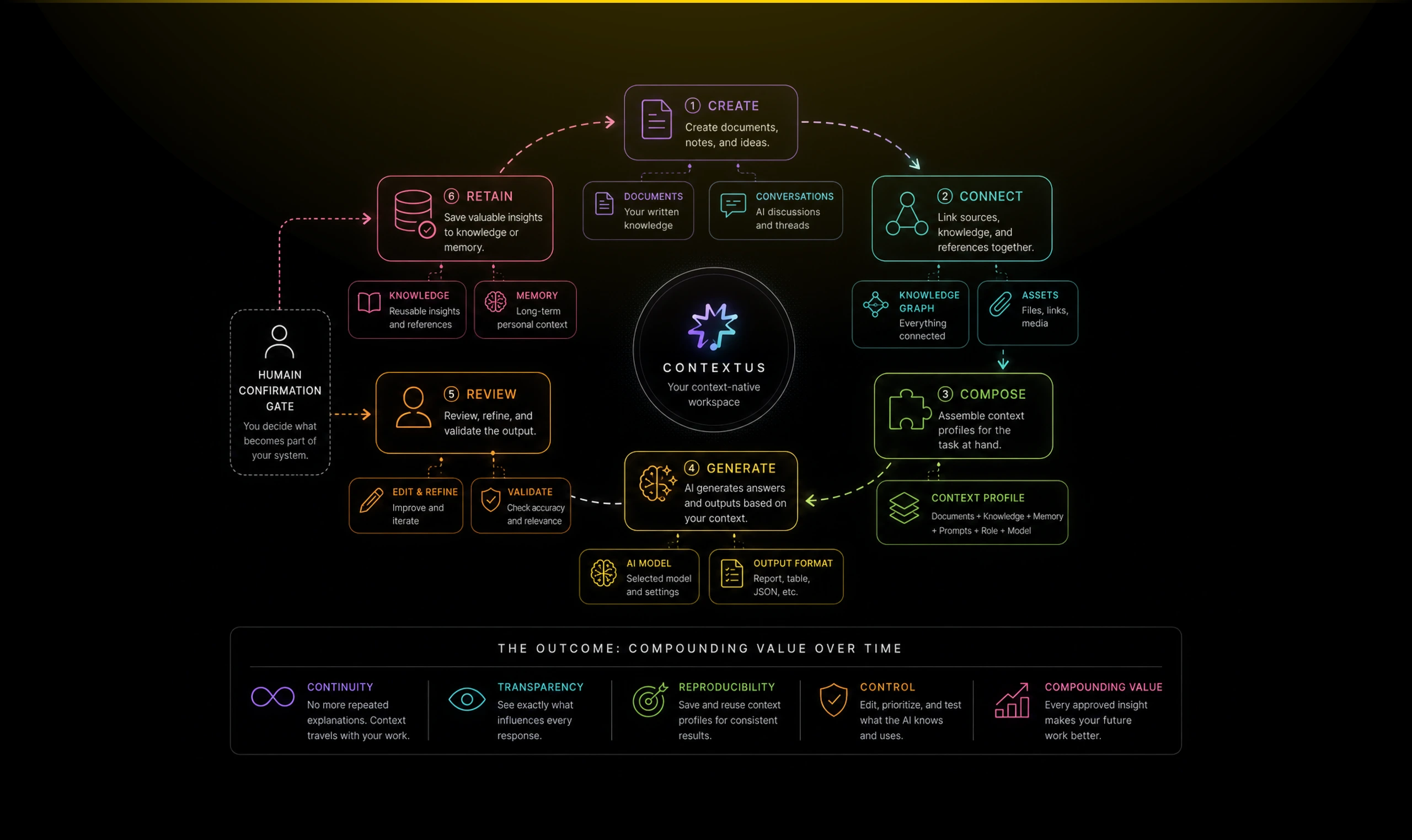
The most meaningful outcome is not a single feature or screen. It is a clearer operating model for sustained human-AI work:
- Less repeated explanation, because relevant knowledge persists
- Greater reproducibility, because reasoning environments can be saved
- More transparency, because sources and memory remain visible
- Stronger user control, because context can be edited, toggled, and tested
- Compounding value, because useful outputs return to the knowledge system
This project brought together several themes that define my work: knowledge architecture, complex workflow design, visual orchestration, human oversight, and technically grounded AI product thinking.
It also reinforced a broader conviction. The next generation of AI products will not be differentiated only by which model they use. Their value will depend on how well they help people structure, govern, and reuse the context around those models.
The Problem
Powerful models were still operating inside disposable workflows.
Knowledge workers were already using AI throughout research, writing, product strategy, and technical planning. But the surrounding workflow remained fragmented.
Documents lived in one application. Prompts were copied between notes. Important conversations disappeared into long chat histories. User preferences had to be restated repeatedly. Supporting files were attached manually, often without any clear indication of whether the model had used them effectively.
The larger problem was not simply context loss. Users also lacked visibility.
A response could appear intelligent, but there was rarely a reliable way to inspect which documents, memories, instructions, or previous conversations had influenced it. When an output was weak, users had little ability to diagnose why. When an output was excellent, reproducing the same reasoning conditions was equally difficult.
This created three recurring forms of friction:
- Reconstruction: users repeatedly rebuilt the same background information.
- Fragmentation: documents, prompts, conversations, and knowledge remained disconnected.
- Opacity: the inputs governing AI behavior were largely invisible.
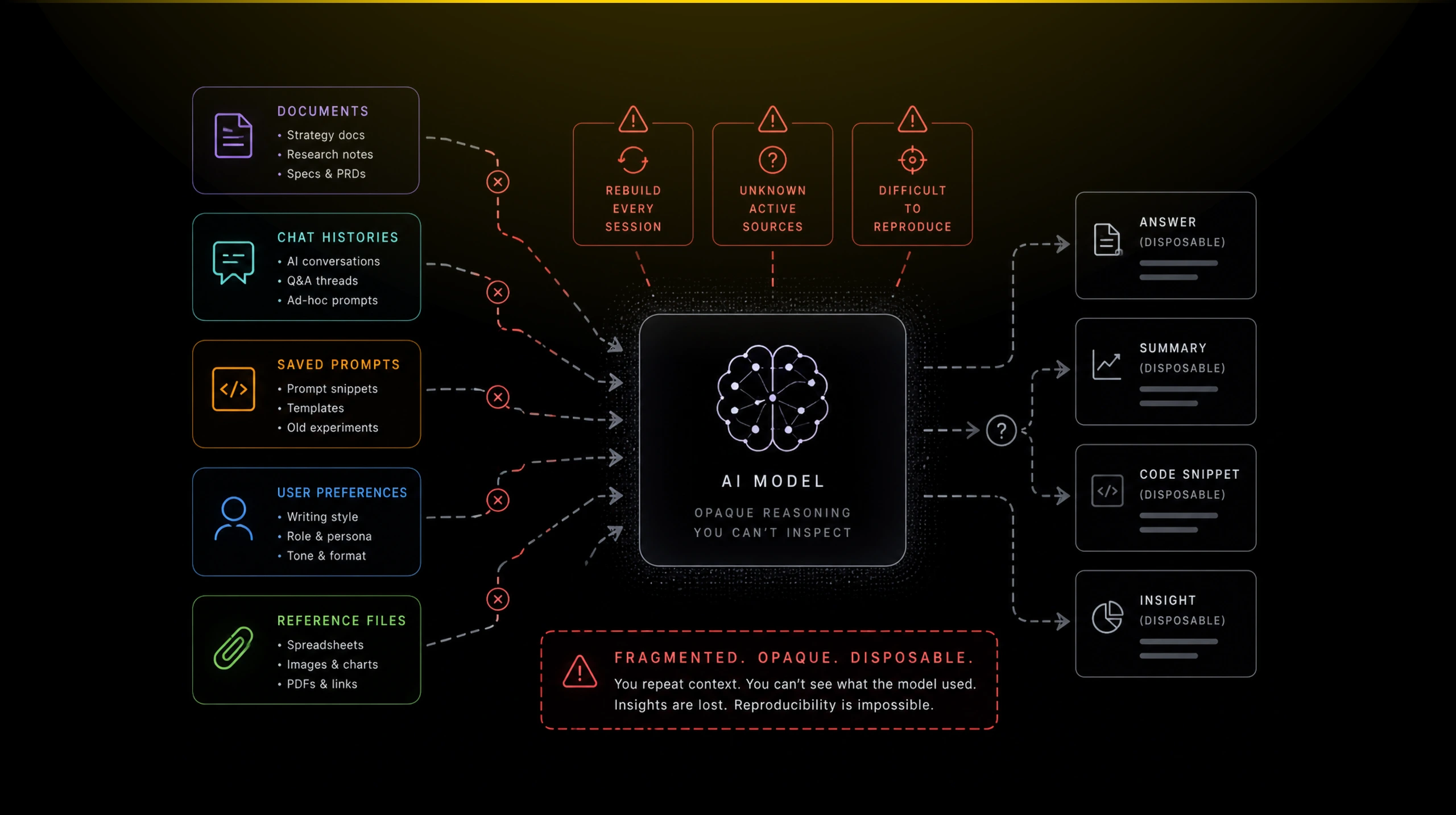
The product challenge was therefore larger than designing another chat interface. I needed to define a system in which context could be treated as a durable product object, one that users could assemble, inspect, edit, save, and reuse.
Solution
Turning context from a hidden side effect into a product layer.
I began with a simple product principle: users should be able to see and control the environment in which the AI is reasoning.
That principle shaped Contextus into three interconnected modes:
- Workstation, where users write, organize knowledge, and collaborate with AI
- Context Builder, where they assemble reusable reasoning environments
- Memory, where persistent personal and business knowledge can be reviewed and governed
The important design decision was to avoid treating these as separate utilities. Each mode needed to participate in the same information loop.
A document could become a context source. A conversation could remain linked to the document that produced it. A useful response could become a knowledge entry. A newly discovered fact could become persistent memory. Those objects could then be recombined inside a saved Context Profile and used again.
Keeping AI inside the work.
The Workstation combines a structured document editor with a context-aware assistant. Users can write directly, invoke AI through inline actions or slash commands, and continue a related conversation without leaving the document environment.
The active Context Profile remains visible in the editor and assistant panel. Users can inspect the participating documents, knowledge entries, conversation history, prompts, and memory, then temporarily disable individual sources when they want to test how the response changes.
This was a deliberate alternative to copy-and-paste AI workflows. The document does not need to be manually introduced to the assistant because it already exists as a governed source inside the active environment.

The assistant also detects information that may be worth retaining. Instead of silently storing it, Contextus presents the candidate memory to the user with explicit Confirm and Ignore actions.
That human checkpoint matters. Persistent memory is useful only when users understand what is being retained and remain able to reject incorrect or overly broad conclusions.
Making reasoning environments reusable.
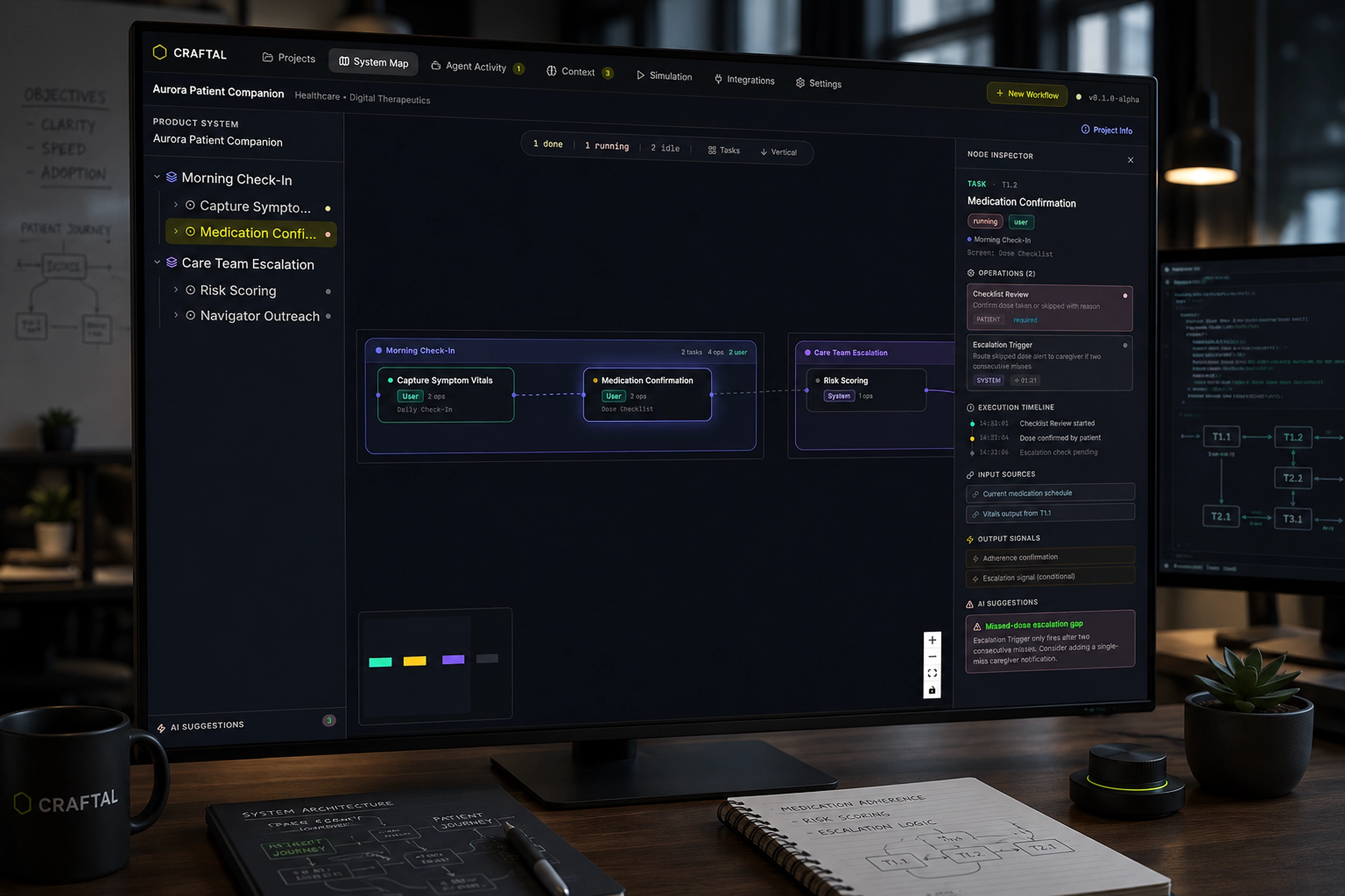
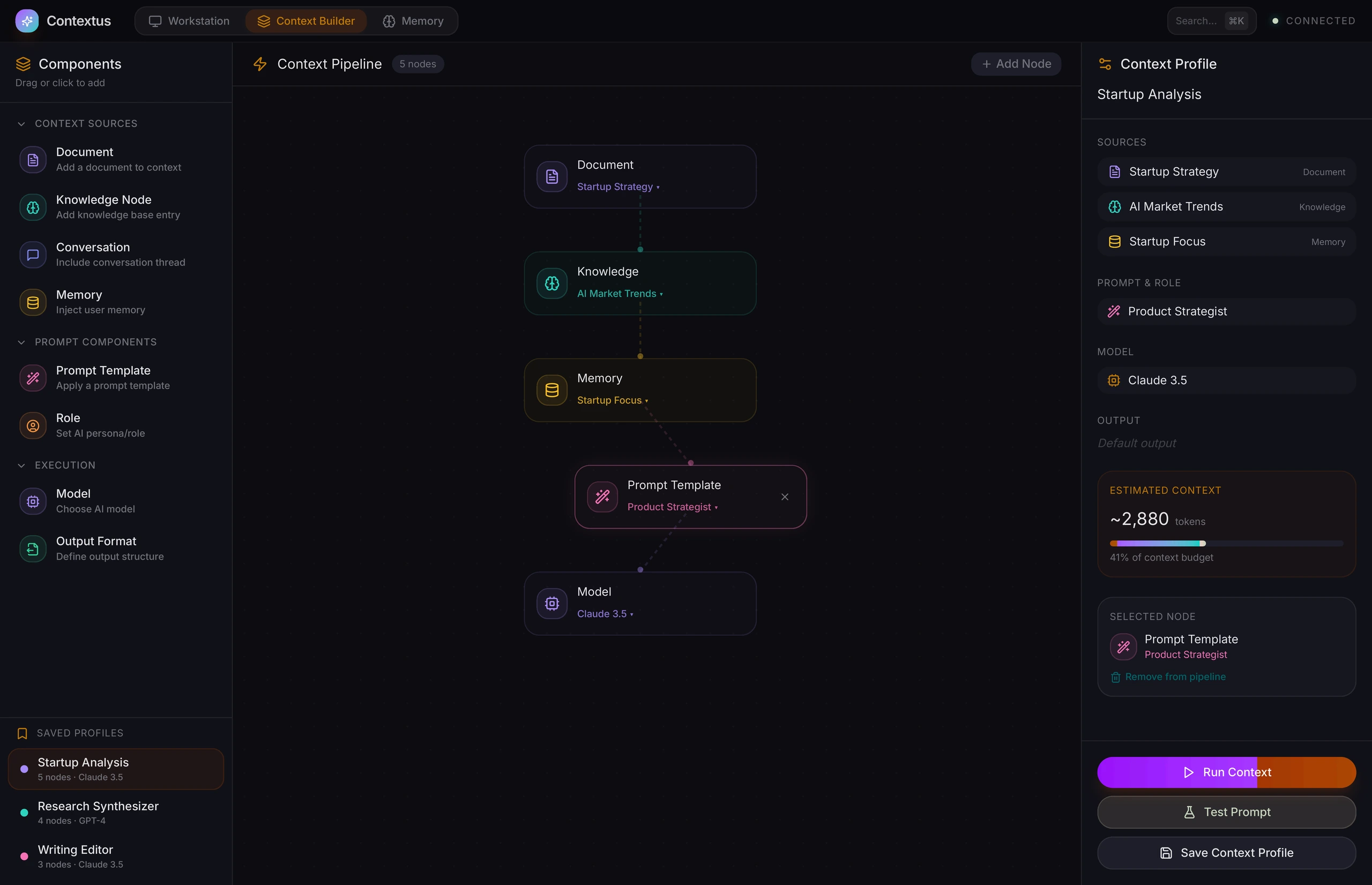
The Context Builder turns the AI input layer into a visual pipeline.
Users can combine documents, knowledge entries, conversations, memory, prompt templates, roles, models, and output formats. Each component appears as a visible node, while an inspector summarizes the complete profile and estimates its context cost.
The key abstraction was the Context Profile: a named, reusable configuration describing the conditions under which a type of work should happen.
For example, a product strategy profile might combine:
- A strategy document
- Competitive research
- Business memory
- A product strategist prompt
- A selected model
- A structured report format
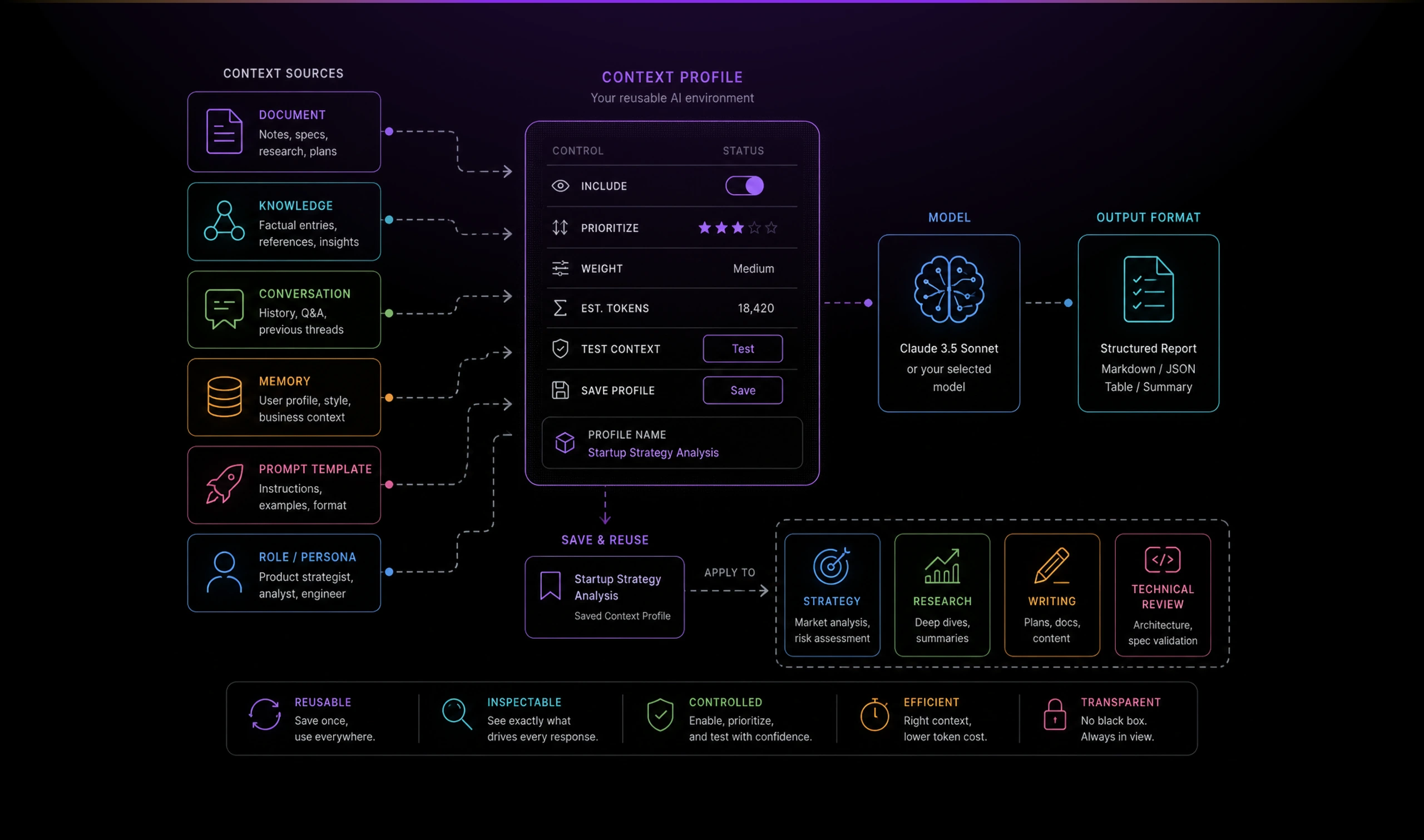
Once saved, that reasoning environment can be applied repeatedly without reconstructing its ingredients. I also exposed estimated token usage as part of the configuration. More context is not automatically better context. A useful context-engineering tool should help users understand both relevance and cost, rather than encouraging them to attach everything available.
Designing memory as governed infrastructure.
Most AI memory experiences behave like hidden personalization settings. Contextus instead presents memory as a structured, editable system.
Entries are organized by categories such as user profile, writing style, business context, technical preferences, projects, and AI preferences. Each entry includes:
- A key and value
- A priority level
- Its source, such as manual, extracted, or imported
- A usage history showing how often it has influenced a request
The Memory Impact panel previews how the current configuration is likely to affect AI behavior. It also estimates the context weight and token cost of each category. I wanted users to understand not only what the system remembered, but what that memory was likely to do.